20 October 2026
Estimated reading time: 5 min
Career competencies: developing the person behind the professional journey
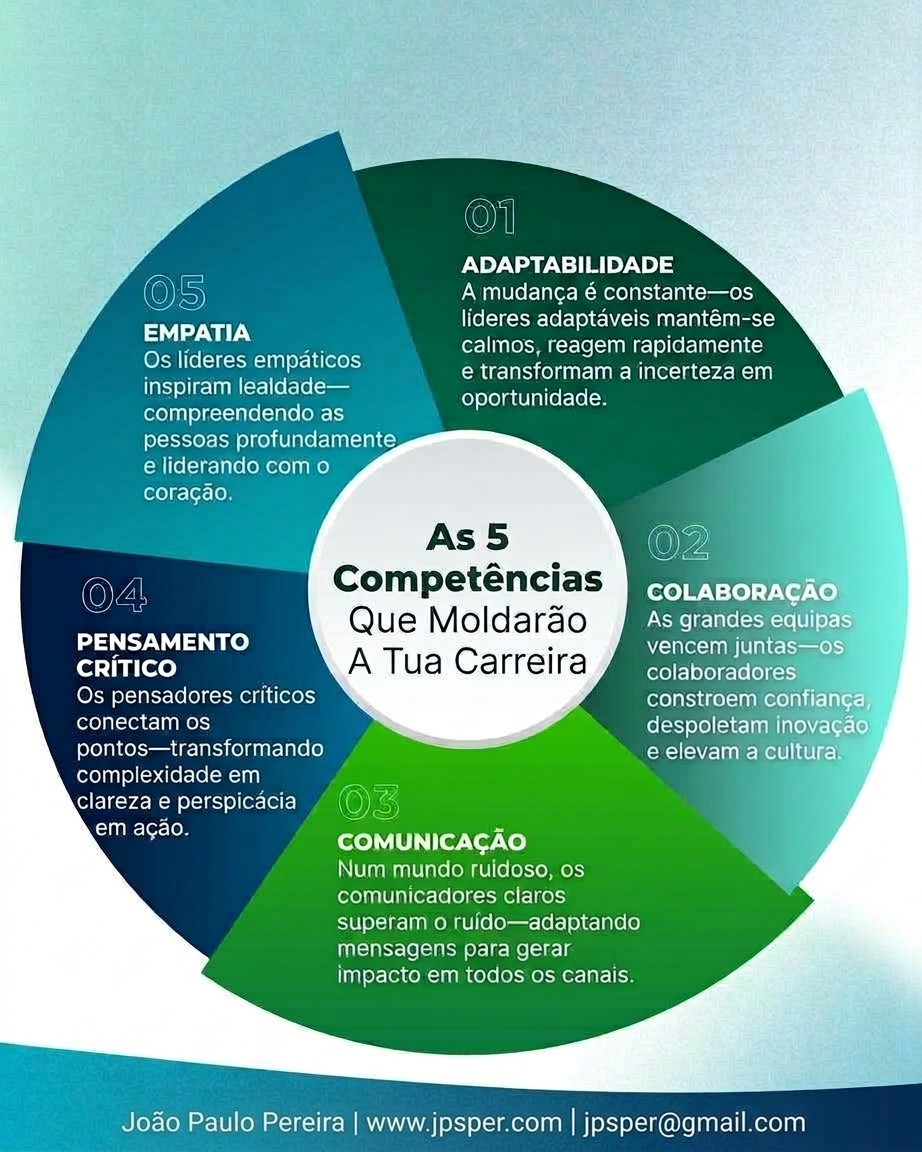
A career is not built only on qualifications or experience. It also depends on how we learn, relate to others and make decisions. Developing your career involves developing yourself: understanding your values, recognising limits and choosing a path consistent with the life you want to build.
The image identifies five competencies: adaptability, collaboration, communication, critical thinking and empathy. These are capabilities we can learn and practise, not an exhaustive list. Coaching can support their development by helping clarify goals and test behaviours, without taking ownership of your decisions.
1. Adaptability: changing without losing direction
Adaptability means adjusting your response when tasks, tools or circumstances change. It does not mean accepting everything or always feeling calm. It requires recognising feelings, tolerating some uncertainty and distinguishing what you can influence from what you cannot control. Learning a new approach need not mean abandoning your values.
Practice: when something changes, record what has changed, what you need to learn and one feasible first step. Experiment, gather feedback and adjust. Coaching can explore fears and prepare alternatives. Its advantage is turning vague concern into concrete decisions, without confusing flexibility with submission to excessive workload.
2. Collaboration: building with others
Collaboration means sharing information, honouring commitments and handling differences around a shared goal. Personal development requires humility, trust and responsibility: asking for help does not reduce professional worth, and helping does not mean permanently taking on someone else’s work. Constructive disagreement can improve a team’s decisions.
Practice: clarify who does what, who decides and how difficulties will be raised. Invite a different perspective before closing a decision. Coaching can help identify excessive control, conflict avoidance or difficulty delegating, supporting more balanced relationships and clearer commitments. The aim is healthy interdependence, not dependence on others.
3. Communication: clarity, listening and assertiveness
Good communication makes a message understandable and checks how it was received. It involves listening, adapting language and expressing needs respectfully. Emotional awareness helps recognise when fear of displeasing others leads to silence or frustration becomes aggression. Being assertive means respecting both your needs and the other person’s.
Practice: structure a message around fact, impact and request: “We still need the data; without it I cannot validate the report; can we agree delivery for Wednesday?” Then listen. Coaching allows rehearsal of requests, presentations or difficult conversations, providing preparation and clarity without dependence on a rigid script.
4. Critical thinking: deciding with criteria
Critical thinking means assessing sources, distinguishing facts from interpretations and comparing alternatives. It requires humility to revise conclusions and acknowledge bias. A convincing answer, including one produced by artificial intelligence, is not necessarily true: check information before acting. Seeking only evidence that agrees with you can narrow your options.
Practice: when considering a job change, compare learning, pay, stability and effects on personal life, not only the title. Ask: “What information would change my mind?” Coaching can respectfully challenge assumptions, explore scenarios and identify missing information. The decision remains yours; the practitioner should not simply confirm your existing story.
5. Empathy: understanding and keeping boundaries
Empathy means trying to understand another person’s experience without assuming you already know it. It does not mean agreeing with everything, excusing every behaviour or absorbing other people’s problems. It develops through curiosity, listening and a relationship with yourself that recognises difficulties without treating every mistake as a personal condemnation.
Practice: replace “You are not committed” with “I have noticed difficulties meeting deadlines. What is happening?” Check understanding and agree responsibilities. Coaching can help explore other perspectives and automatic reactions. Its advantage is more conscious relationships, with boundaries and fewer premature interpretations. Understanding someone does not remove the need for accountability.
What coaching adds — and what it cannot replace
These competencies work together: sound analysis that is poorly communicated may never be used; empathy without boundaries may create overload. Coaching offers structured space to recognise patterns, define goals, test behaviours and review results. Potential advantages include clarity, preparation for decisions and continuity in learning, rather than a promise of promotion.
Meta-analyses find average benefits of workplace coaching in learning, performance and some individual outcomes. These are not guarantees for everyone. Process quality, the relationship and opportunities to practise matter. Choose a trained, ethical practitioner; agree goals, costs, duration and confidentiality, including its limits when an employer funds the process. You should also be able to review or end an unhelpful arrangement.
Coaching does not replace technical training, mentoring or psychotherapy, nor does it itself treat anxiety or depression. Persistent distress calls for health assessment. It cannot remedy harassment, discrimination or insufficient resources: organisations remain responsible for working conditions and psychosocial risk prevention. Individual development should never mean learning to tolerate harm.
Getting started: one competency, one observable change
Choose a recurring situation and one competency. Define a concrete behaviour for the next two weeks: “I will clarify my request and check understanding in meetings.” Practise, ask for feedback and record the effect. Then adjust and decide whether training, mentoring or coaching would help. Start with something achievable within your available time and resources.
Progress is not merely feeling better during a session: it means observing more useful choices and behaviours. A meaningful career requires learning and decent conditions. If you want to clarify a change or develop these competencies, I am available to discuss support appropriate to your journey. Your career deserves attention, and so does the person building it.
Sources and further reading
World Economic Forum (2025). The Future of Jobs Report — Skills outlook.
Jones, Woods & Guillaume (2016). The effectiveness of workplace coaching: a meta-analysis.
Theeboom, Beersma & van Vianen (2014). Does coaching work? A meta-analysis.