19 October 2026
Together for mental health at work: the 2026–2028 campaign
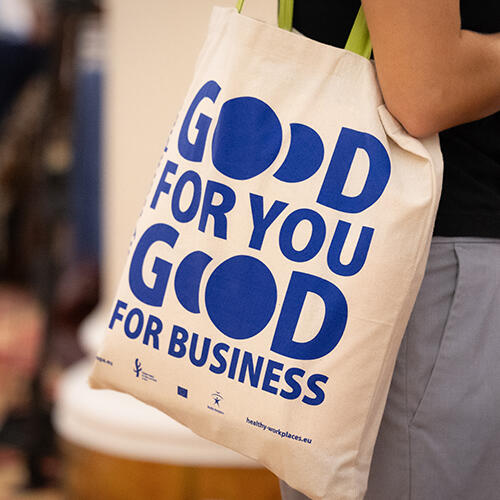
For the 2026–2028 biennium, the European Agency for Safety and Health at Work (EU-OSHA) is launching a new edition of the "Healthy Workplaces" campaign, this time fully dedicated to mental health: "Together for mental health at work".
The campaign slogan — "Good for you, good for business" — sums up, simply, what I have believed for more than three decades: caring for the mental health of working people is good for people and good for organisations. It is not a cost, it is an investment; not an accessory, but a condition for sustainable performance.
The choice of theme is no coincidence. Stress, burnout and unfavourable working conditions are among the problems most reported by European workers, and the prevention of psychosocial risks is now recognised as an integral part of managing safety and health at work — on the same level as other occupational risks.
Why this edition matters
Mental health at work can no longer be treated as a marginal topic. It cuts across sectors, roles and levels of hierarchy, and shows up both in situations of excessive workload and in situations of underused skills, conflict or lack of meaning in what we do.
The 2026–2028 campaign places this theme at the centre of the occupational safety and health agenda across all countries of the Union. A two-year campaign has a value that goes beyond visibility: it creates a common framework, with shared goals, materials and moments, and gives organisations a point of support to start or consolidate their work in this area. Nobody starts from scratch — we join a European movement.
There is also a practical reason: EU-OSHA campaigns provide free guides, materials and good examples in several languages. For many organisations — especially small and medium-sized ones, which do not always have specialised structures — this is concrete support for taking the first step or for confirming that the path already taken points in the right direction.
An opportunity to share good practices
This edition is an opportunity for organisations, workers, partners and other occupational safety and health stakeholders to share good practices for preventing psychosocial risks at work.
And there is indeed much to share: assessing psychosocial risks with appropriate instruments; involving people in identifying problems and solutions; training leaders to recognise signs of burnout and act early; balancing workload; building climates of trust and psychological safety; and integrating mental health into how the company is organised and managed, rather than in one-off actions.
Sharing is essential because the prevention of psychosocial risks is not a closed recipe. Every organisation has its own culture, challenges and people — but nobody needs to start from the beginning. One organisation's good practices are another's inspiration.
Sharing good practices is also an exercise in organisational generosity: it means acknowledging that problems exist, showing how they were solved and allowing others to move faster. The campaign exists precisely to make that sharing visible, structured and useful.
What psychosocial risks are
Psychosocial risks are the working conditions that can harm people's mental and physical health: excessive or unbalanced workloads, lack of control over one's own work, difficult or violent relationships, unclear roles, insecurity, poorly managed change or disrespect. They are not "people problems": they are features of the way work is organised — and that is precisely why they can be prevented.
Their effects are well known: prolonged stress, anxiety, burnout, sleep disorders, absenteeism and presenteeism, falling engagement and quality of work. So are their costs: for the person, who suffers; for the team, which feels it; for the organisation, which loses capacity, talent and reputation.
The good news is that these risks can be measured, prevented and corrected. Regular assessment, listening to people, acting on the organisation of work and follow-up over time are the backbone of any serious intervention in this area.
Where we start, in Portugal
In Portugal, we have standards that give structure to this work: NP 4590, on psychosocial risk at work; NP 4552, on mental health at work; and ISO 9001, which ensures the organisation and management of processes. Validated assessment instruments, such as the PPJM and COPSOQ III, allow for a rigorous diagnosis and for tracking progress over time.
The accumulated experience of assessment and intervention in hundreds of organisations shows that it is possible to act with rigour and obtain measurable results. The European campaign thus meets what is already possible to do with Portuguese organisations — and creates a window of opportunity for those who have not yet taken this step.
A commitment reaffirmed
In this context, I reaffirm my commitment of social responsibility, which I have maintained for more than 30 years, in the prevention and promotion of mental health in the workplace: supporting companies, teams and people in building workplaces where mental health is protected, promoted and integrated into the way work is organised.
This commitment is not a statement of intent: it is a concrete path, made of assessments, intervention plans, leadership training and follow-up of results, in the service of public and private organisations.
Joining the campaign is a concrete gesture in that direction. Even more important is turning participation into practice: assess, intervene, measure and improve, continuously.
Together for mental health at work
Mental health at work is good for people and good for organisations. Over the next two years, those who join this European effort have much to gain — and, above all, so do the people who bring work to life every day.
For those who have not yet joined, the next two years open a door: take part in the campaign, get to know the good practices being shared and start — or continue — your own path towards a safe and healthy workplace.
Count on me.
Healthy Workplaces Campaign 2026–2028 · healthy-workplaces.eu